Key takeaways
- A real Muay Thai session almost always follows the same shape wherever you train in Thailand: warm-up, pad or technique work, bag work, clinch, conditioning, run on 3-minute rounds.
- Your first week hurts more on day three or four than on day one. 65.4% of combat athletes in a 2025 study reported at least one training injury, most often to the leg, not the head (Swiss Dental Journal SSO, 2025).
- Regulated competition is more controlled than most people assume: only 10.25% of 663 athletes needed ringside medical treatment across 591 matches in a separate 2025 study (Injury Epidemiology).
- Most gyms have loaner gloves for a first class. You do not need to own gear until you decide to keep training past session one.
- A big camp and private 1-on-1 training solve different problems. First-timers who want technique corrected before joining a group tend to start better with private hours.
What actually happens in a Muay Thai session
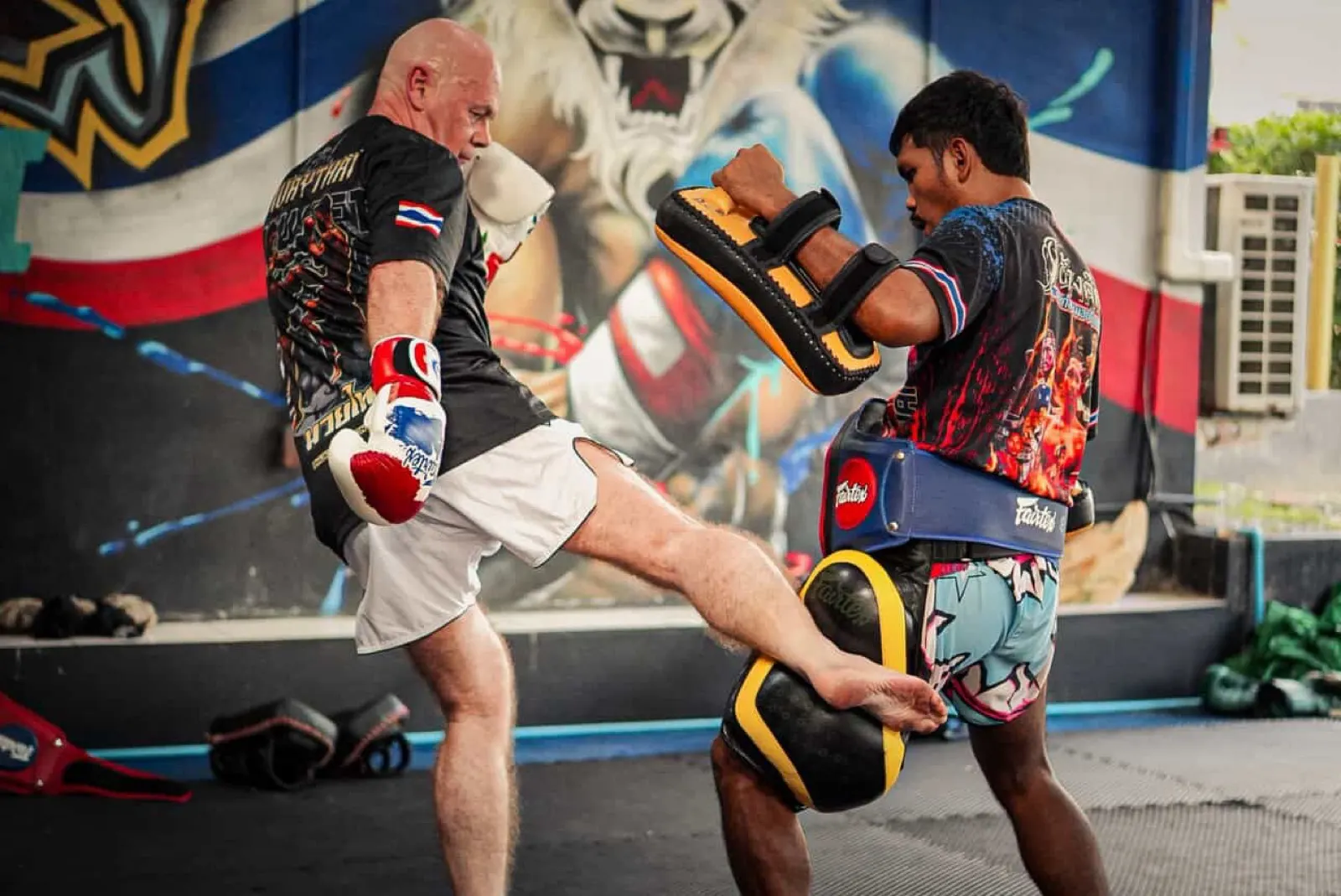
A Muay Thai session in Thailand almost always runs the same rough shape, whether you are in a beach-town gym or a stadium camp: a warm-up, then pad or technique work, then bag work, then clinch, then conditioning. Rounds are run on a clock, and in Thailand that clock is nearly always 3 minutes, the same length used in professional fights, rather than the 2-minute rounds common in amateur boxing elsewhere (muaythai.com, checked 17 September 2026).
Full-time fighters inside a camp typically train twice a day: a morning block built around running, skipping rope and 3 to 5 rounds each of bag work and pad work, then an afternoon block built around 3 to 5 rounds of sparring and clinch wrestling, with 2 to 4 hours of rest between them (muaythai.com, checked 17 September 2026). If you are booking a single class or a short private block rather than living at a camp, you get a compressed version of the same shape inside one hour: a warm-up, several pad rounds where the trainer calls combinations and corrects what you throw, some bag work, an introduction to clinch, and a conditioning finisher.
Clinch deserves its own mention, since it surprises most first-timers. Clinch fighting, close-range grappling for knees and off-balancing, is a core part of the sport in Thailand in a way it rarely is at a Western kickboxing gym, and most Thailand gyms dedicate specific rounds to it rather than treating it as an afterthought.
What your first week actually feels like
Day one and two usually run on adrenaline. The difficulty tends to peak on day three or four, when shins ache, shoulders burn, and muscles you did not know you had start to complain. By day five to seven, most people's bodies adapt and technique starts to stick better than it did on day one (World Muay Thai Magazine, March 2026). As that guide puts it bluntly: training in Thailand is humbling, and you will be slow, uncoordinated and tired for the first week regardless of your background.
What you are feeling by day three has a name: delayed onset muscle soreness, or DOMS. It is caused by microscopic tears in muscle fibers during unfamiliar or intense movement, typically shows up one to three days after the session that caused it, and usually clears within about a week (Cleveland Clinic, reviewed 19 December 2025). Warming up properly, easing into new movements gradually, and stretching afterward all reduce how bad it gets, per the same source. None of this means you are doing it wrong. It means your body is adapting to something it has not done before.
Plan your first week around the soreness curve rather than against it. Book fewer, shorter sessions in days one to four than you think you want, then add volume once day five or six arrives and your body has caught up.
What to bring (and what you do not need yet)
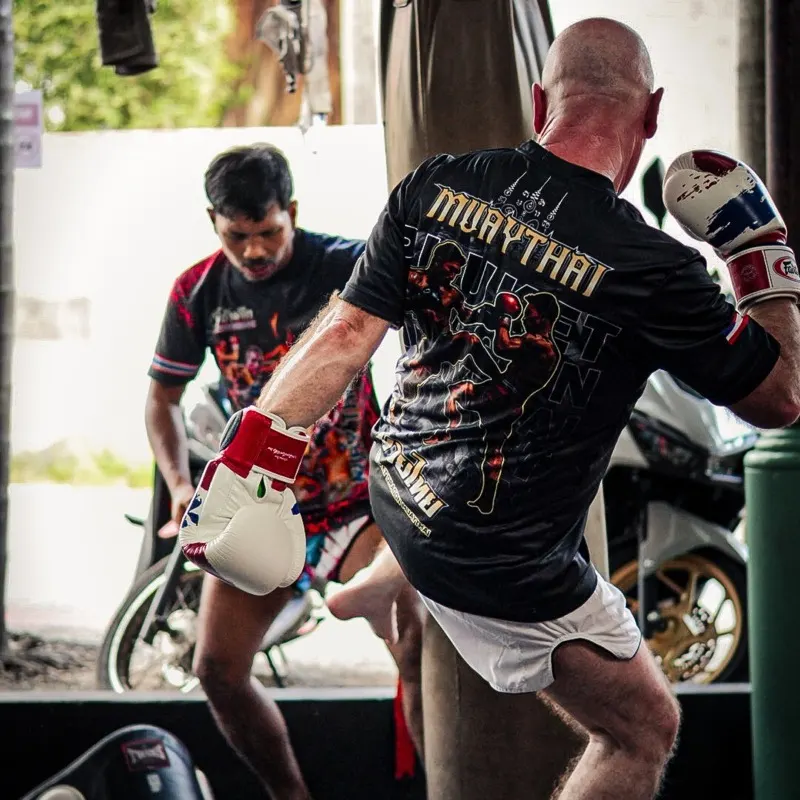
For a genuine first class, bring almost nothing beyond clothes you can move in, a towel and a water bottle. Muay Thai is trained barefoot, and most gyms keep loaner gloves for new arrivals, so there is nothing to buy before you try it once (ONE Championship, checked 17 September 2026). Once you decide to keep training, the same source recommends building up gear roughly in this order: your own gloves, hand wraps to protect the small bones and tendons in your hands, a mouthguard, then shin guards once sparring or shin-conditioning drills start. Ankle wraps and a bottle of traditional Namman Muay warming oil are common extras once you are training regularly, not day-one essentials.
At Dragon Muay Thai, equipment is included in a private session with Kru Marn, so a first hour there needs nothing more than clothes and water. That is not true everywhere. If you are training at a gym you have not visited before, a quick message asking whether gloves and wraps are provided saves an awkward first fifteen minutes.
| Stage | What you need | Why it can wait (or not) |
|---|---|---|
| First class only | Clothes you can move in, a towel, water | Most gyms keep loaner gloves and pads for new arrivals |
| First few weeks | Your own gloves, hand wraps | Wraps protect the small bones and tendons in your hands from day one of regular training |
| First month | Mouthguard | Worth owning before any contact drilling starts, not just before sparring |
| Once sparring starts | Shin guards | Needed once drills move to shin-to-shin contact |
| Optional extras | Ankle wraps, Namman Muay oil | Common once training regularly, not day-one essentials |
Gear progression per ONE Championship's own gear guide, checked 17 September 2026. At Dragon Muay Thai, equipment for a private session is included, so the "first class only" column is all you need there even past week one.
Injury and safety basics nobody tells you up front
Training has a real but mostly minor injury profile, and it skews toward the legs rather than the head. A 2025 survey of 419 combat athletes found that 65.4% had sustained at least one injury during training, with the leg the single most common site, affecting 74.8% of those who reported an injury (Swiss Dental Journal SSO, 2025). That figure includes everything from minor shin bruising to a pulled muscle, not just injuries serious enough to stop training.
Regulated competition, where people often expect the real risk to be, turns out to be more tightly controlled than most beginners assume. A 2025 study tracking 663 competitive Muay Thai athletes across 591 matches at the Turkish Championships found that only 10.25% needed any ringside medical treatment, 8.60% had their match stopped by referee decision, 2.56% were referred to hospital, and just 0.15%, effectively one athlete, required surgery (Injury Epidemiology, May 2025).
The practical takeaway sits between the two studies rather than at either extreme. Training regularly produces minor, mostly leg-related soreness and strain for most people, which is manageable with rest and is not a reason to avoid it. Supervised competition, despite the reputation, has a well-documented safety net around it. A few habits reduce risk on both sides: cover any open cuts before training, since skin infections spread faster in tropical heat and humidity, shower soon after a sweaty session, keep fingernails and toenails trimmed, and wash gear rather than leaving it to sit in a bag (Evolve Daily, checked 17 September 2026; World Muay Thai Magazine, March 2026). Pacing yourself at roughly 70% effort in a first week rather than maxing out every round, and taking a rest day when something feels off rather than pushing through it, matters more than any piece of gear.
How Thai gym culture is different from a class back home
The biggest difference is not the kicks. It is who the session is built around. A Western group fitness class is usually built around the clock, everyone doing the same drill on the same count. A Thai gym is usually built around the pad holder, one trainer working combinations with one student at a time even inside a group class, which is why pad rounds move at whatever pace that pairing needs rather than a fixed group tempo.
Respect for the trainer runs deeper than in most Western gyms too. The wai, palms together with a slight bow, is the standard greeting for a kru, and Thai culture places teachers in a position of real authority earned over years, not just a job title (Kru Muaythai Association, an organization accredited by Thailand's Ministry of Culture and Education since 2003, checked 17 September 2026). That respect shows up ringside too: before a professional fight, Thai boxers perform the wai khru ram muay, a ritual dance paying respect to their trainer, parents and training lineage, which is worth watching once even if you never fight yourself. Day to day, the practical rules are simple: shoes off the mats and out of the ring, feet pointed away from people and the ring rather than toward them since feet are considered the lowest part of the body in Thai culture, and full attention on the trainer during a demonstration rather than chatting through it (World Muay Thai Magazine, March 2026; Evolve Daily, checked 17 September 2026).
Where in Thailand should you actually train?
This guide is not a hub-by-hub comparison, but it is worth a quick orientation before you book flights. Bangkok has the country's top stadiums, Lumpinee and Rajadamnern, plus elite gyms training professional fighters, but it is a dense, expensive city better suited to serious fighters than a relaxed first trip. Chiang Mai runs several full-time professional stadiums and has a reputation among longtime trainees for affordable, culturally rooted training away from the beach-resort atmosphere. Pattaya has gyms too, but is better known for nightlife than for being a training-first destination. Phuket has become one of the busiest hubs in the country, with the island's density of camps, trainers and competition venues specifically called out in a 2025 tourism study as a reason foreign visitors choose it (Journal of Sports Science and Technology, March 2025; YOKKAO, checked 17 September 2026). Soi Ta-iad, also called Fitness Street, is Phuket's own cluster within that hub, and it is where Kru Marn teaches; a full guide to that street covers what is actually on it.
If you are planning a stay longer than a couple of weeks, one fact changes the plan. Thailand's special Muay Thai training visa was extended from a 60-day maximum stay to 90 days, and can reportedly be renewed up to three times for a stay of roughly one year, provided you train at a gym certified by the Sports Authority of Thailand (Mothership, checked 17 September 2026; NOW Muay Thai, checked 17 September 2026).
Group camp or private training: the real first decision
Wherever in Thailand you land, the choice that shapes your whole trip is not which gym's logo you like most. It is whether you start in a group or with a trainer watching only you. A big commercial camp sells a bundle: a dorm, a class timetable, training partners, and at some, a route toward a real fight. Private training sells one thing, a trainer's undivided attention, with every rep corrected as you throw it rather than reviewed at the end of a group round. Neither is wrong. A full breakdown of that tradeoff, including what Phuket's biggest camps actually charge compared with private hours, is covered in a separate guide, so this one will not repeat it.
What is worth saying here: if you have never thrown a kick before and do not want to learn the basics in front of a room of strangers, starting with a private hour or two is the easier on-ramp. It removes the two variables that make a first group class intimidating, an unfamiliar room and an unfamiliar body, and leaves just one to deal with at a time.
What a first private hour with Kru Marn looks like
Kru Marn is a former Southern Thailand Champion with 180 professional fights, 150 wins, and more than 15 years teaching, based at Dragon Muay Thai on Soi Ta-iad, Phuket. Prices checked 17 September 2026: a single session is ฿700, a 20-session package is ฿14,000, and a Padholder Course, 10 one-hour sessions aimed at people who want to learn to hold pads properly rather than just be hit by them, is ฿12,000. Dragon Muay Thai also offers accommodation for visitors who want to stay where they train; pricing has not been published yet, so ask directly on WhatsApp for current room details rather than trusting a number found elsewhere.
For the minute-by-minute version of what a first hour actually involves, a separate guide covers your first Muay Thai session in full. For how the full cost compares with other Phuket gyms, see the private training cost guide.
Frequently asked questions
Do I need to be fit before I start Muay Thai training in Thailand?
No. Gyms and private trainers scale the pace to whoever is in front of them, and a first session is built around a complete beginner by default. You will be more useful to yourself if you can jog for ten minutes and touch your toes, but plenty of people start their first week in Thailand carrying extra weight or no training background at all. The fitness comes from the training, not the other way around.
How sore will I actually be after my first few sessions?
Sorer than you expect, and it peaks around day three or four before it eases off. That is delayed onset muscle soreness, a normal response to unfamiliar movement that Cleveland Clinic notes usually resolves within about a week (checked 17 September 2026). Shins in particular take time to condition. A dull, aching soreness is normal; sharp or joint-specific pain is not, and is a sign to rest.
Is Muay Thai training safe, or is the injury risk as high as people assume?
Training carries a real but mostly minor injury risk, usually to the legs rather than the head. A 2025 study of 419 combat athletes found 65.4% had experienced at least one training injury, most commonly to the leg (Swiss Dental Journal SSO, 2025). Regulated competition, by contrast, is more tightly controlled than most people assume: a separate 2025 study of 663 competitive Muay Thai athletes found only 10.25% needed ringside medical treatment across 591 matches (Injury Epidemiology, May 2025).
Do I need my own gloves and wraps for a first class?
Usually not for a single first session. Most gyms keep loaner gloves and pads for new starters, so there is nothing to buy before you try it once. Once you decide to keep training, hand wraps and a pair of gloves are worth owning yourself for hygiene and fit. At Dragon Muay Thai, equipment is included in a private session with Kru Marn, so you can turn up with just clothes and a water bottle.
Should I start with a group camp or private lessons?
If you have never trained before and want your technique corrected as you throw it, rather than reviewed at the end of a group round, private hours are the easier way to start. If you want a dorm, a class timetable and training partners from day one, a camp fits better. A full breakdown of the tradeoff, including what Phuket's big camps actually charge, is covered in a separate guide to choosing a training camp.
Start with One Private Hour, ฿700
No dorm to book, no class to keep up with. Former Southern Thailand Champion, 180 professional fights, 15+ years teaching, one trainer working with just you at Dragon Muay Thai on Fitness Street. Equipment included.
Book on WhatsApp See all programs
Kru Marn Muay Thai
Kru Marn (ครูหม่าน) is a former Southern Thailand Champion with 180 professional fights and 150 wins, teaching private Muay Thai in Phuket for more than 15 years at Dragon Muay Thai on Soi Ta-iad. Read more about Kru Marn's fight record and background on the about section, or contact him directly on WhatsApp with questions this guide does not answer. Third-party facts and statistics in this article were checked against their original published source on 17 September 2026.
Sources
- "Muay Thai Workout Routine," Muaythai.com, muaythai.com, checked 17 September 2026.
- "Delayed Onset Muscle Soreness (DOMS)," Cleveland Clinic, my.clevelandclinic.org, reviewed 19 December 2025.
- Robbiani, A.I. and Filippi, A., "From Fitness to Fight: Associations between training motivation and injury prevalence in Muay Thai, K-1 and Kickboxing," Swiss Dental Journal SSO, swissdentaljournal.org, 2025.
- Hallaceli, H., Davut, S., Ozbek, A. and Aydin, E., "Epidemiological analysis of athlete injuries in Muay Thai in-ring matches," Injury Epidemiology, pmc.ncbi.nlm.nih.gov, 26 May 2025.
- "Beginner's Guide to Training Muay Thai in Thailand," World Muay Thai Magazine, worldmuaythaimagazine.com, March 2026.
- "Muay Thai Training Gear You Must Have In Your Gym Bag," ONE Championship, onefc.com, checked 17 September 2026.
- "Muay Thai Gym Etiquette Beginners Need To Know," Evolve Daily, evolve-mma.com, checked 17 September 2026.
- "History of the Wai Kru," Kru Muaythai Association, krumuaythai.or.th, checked 17 September 2026.
- "Development Guidelines and Impacts of Muaythai Sport Tourism in Phuket," Journal of Sports Science and Technology, Vol. 25 No. 1, he01.tci-thaijo.org, March 2025.
- "Where to train Muay Thai in Thailand: Bangkok vs Phuket," YOKKAO, yokkao.com, checked 17 September 2026.
- "Thailand issues special 90-day Muay Thai training visa for tourists," Mothership, mothership.sg, checked 17 September 2026.
- "Muay Thai Soft Power Launched Special 90-Day Muay Thai Visa," NOW Muay Thai, nowmuaythai.com, checked 17 September 2026.
Keep reading
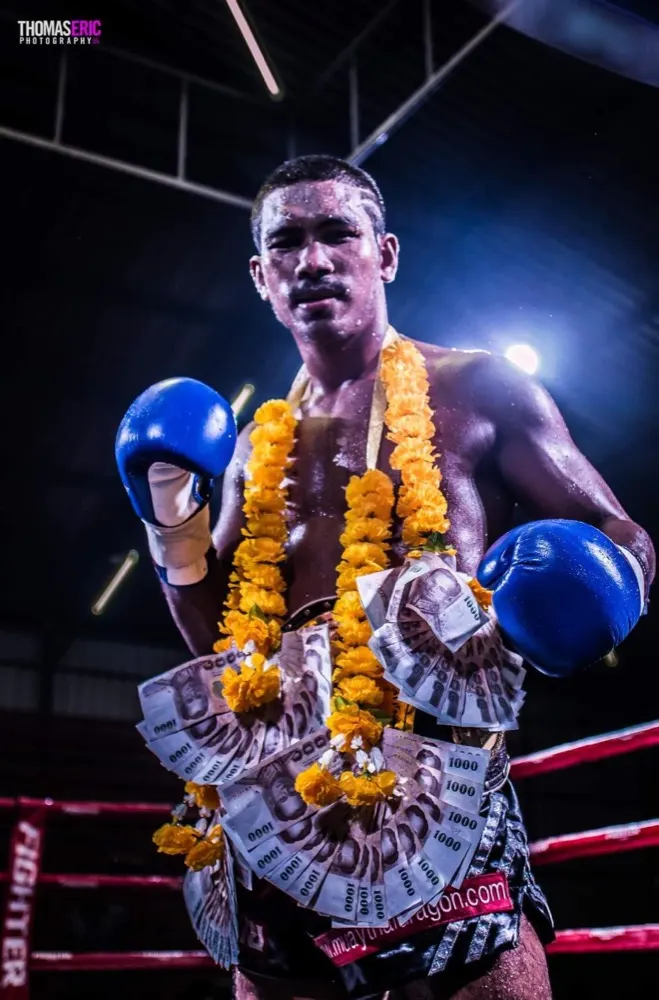
How to Choose a Muay Thai Training Camp in Phuket
Big camps like Tiger and Sinbi sell dorms and group classes. Private training is a different product. How to pick, checked September 2026.
Read the guide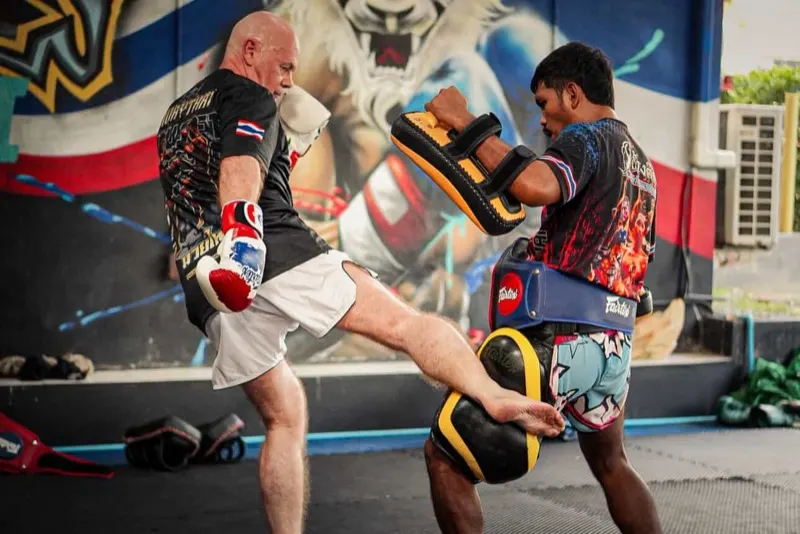
Your First Muay Thai Session: What Actually Happens
The real hour, minute by minute, plus what to bring and the honest answer on age.
Read the guideWhat Does Private Muay Thai Training Cost in Phuket?
Published private rates at six Phuket gyms compared, checked September 2026, plus what the price includes.
Read the guide